
Top 10 Car Parts Every Driver Should Know About
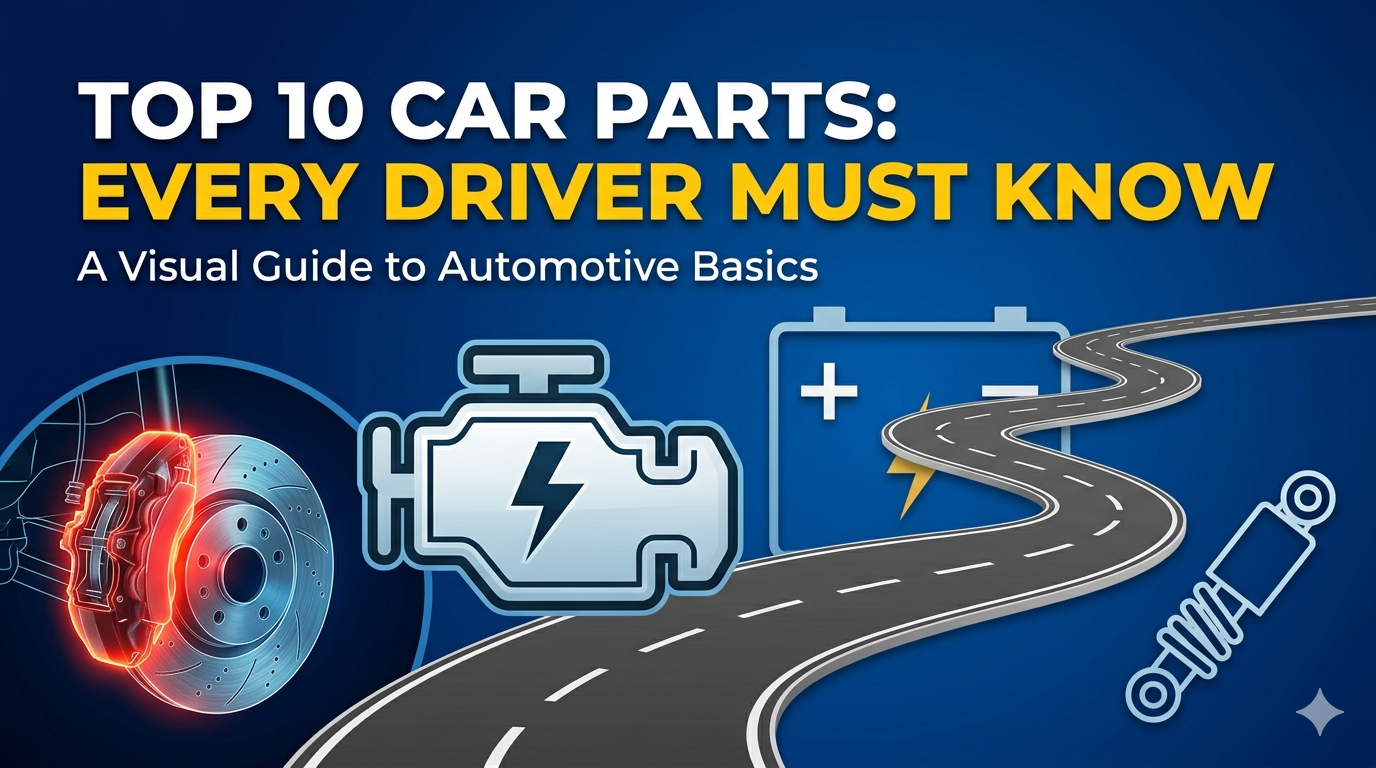
Your car is a complex machine, made up of thousands of individual components working in harmony. While you don’t need to be a certified mechanic to operate a vehicle, having a basic understanding of the key players under the hood—and beneath the chassis—can save you money, keep you safer, and reduce the anxiety of an unexpected breakdown.
Think of it like knowing basic first aid; you don't need to be a surgeon, but knowing how to treat a cut is invaluable. When you understand these top 10 parts, you can better communicate with technicians and catch small issues before they become catastrophic failures.
Here is our countdown of the ten car parts every driver should be able to identify and understand.
1. The Engine (The Heart)
This is the big one. It’s the powerhouse of your vehicle, converting fuel into motion. While modern engines are encased in plastic covers, the core principles remain. This is where combustion happens, generating the rotational force that eventually turns your wheels.
As we discussed in our recent post about the vital importance of timely oil changes, the engine is also the component most sensitive to neglect. Regular maintenance, especially clean oil, is non-negotiable for engine longevity.
2. The Battery (The Spark)
Before the engine can roar to life, it needs a jolt of electricity. That’s where the car battery comes in. The battery stores chemical energy and converts it into the electrical power required to activate the starter motor. It also powers electronics (lights, radio, computer) when the engine is off.
Typically located in the engine bay (though sometimes in the trunk), the battery is recognizable by its positive (+) and negative (-) terminals. If your car won't start and you just hear a clicking sound, the battery is the prime suspect.
3. The Alternator (The Generator)
The battery starts the car, but it doesn't keep it running. Once the engine is on, the alternator takes over. The alternator is a small generator driven by a belt from the engine. Its job is twofold:
-
It recharges the battery while you drive.
-
It supplies electricity to power all of your car’s electrical systems (lights, stereo, ignition) while the engine is in operation.
If your vehicle dies while driving, or if your headlights flicker and dim, your alternator may be failing to charge the system.
Spotlighting Critical Components
The images below highlight how these vital parts are integrated and maintained.
The first image shows a professional technician at work. Note how she is safely working around the engine bay. Her focus here is near the core electrical and fluid systems, reminding us that proper maintenance, as seen in this professional workshop environment, is key to keeping these complex parts functioning.
Next, we look at the specific maintenance of the braking system. The brake caliper, the red component highlighted in the image below, plays a critical role. When you press the brake pedal, hydraulic pressure forces the caliper to squeeze the brake pads against the spinning rotor (the shiny disc). This friction is what stops your multi-ton vehicle. Understanding this system—and knowing that squealing or grinding means these pads are worn out—is crucial for your safety.
4. The Brakes (The Stopping Power)
Your brakes are the single most important safety feature on your car. The complete system involves a master cylinder, fluid lines, and at each wheel, a rotor and a caliper. As shown in our image, the caliper houses the brake pads. This system is sacrificial; the pads are designed to wear down over time. When they are too thin, they stop stopping effectively. Grinding noises mean you've waited too long and are now damaging the metal rotors.
5. The Radiator (The Cooling System)
Engines generate immense heat. If that heat isn't managed, the engine block will warp and seize. The radiator is the heart of the cooling system. Centered at the front of the car, it utilizes airflow to cool a mixture of water and antifreeze (coolant) that has circulated through the hot engine.
A sweet smell (like maple syrup) or steam from under the hood indicates a coolant leak. Never open a hot radiator cap; the system is under pressure and will scald you.
6. The Transmission (The Gearbox)
While the engine creates power, the transmission determines how much of that power gets to the wheels and at what speed. It utilizes a series of gears (like a bicycle) to keep the engine spinning within its optimal power range.
In an automatic transmission, this is handled through hydraulic pressure and a computer. In a manual, you do the work with a clutch and shifter. Rough shifting, hesitation, or leaking red fluid are signs of transmission trouble.
7. Suspension (The Ride Quality)
You don’t just drive on smooth glass. The suspension system, which includes shock absorbers, struts, and springs, is responsible for absorbing bumps and keeping the tires in contact with the road.
If your car bounces repeatedly after a bump, leans excessively in turns, or has one corner that sits lower than the others, your suspension components are worn out.
8. Tires (The Only Point of Contact)
Everything your car does—accelerating, braking, turning—happens through four patches of rubber no bigger than your hand. Your tires are critical. You must know how to:
-
Check Pressure: Improper inflation ruins fuel economy and causes uneven wear.
-
Check Tread Depth: Worn tires (the "penny test") cannot channel water and will hydroplane.
-
Identify Wear Patterns: Wear on only the inside or outside edge indicates an alignment issue (often tied to the suspension, #7).
9. Fuel Injectors (The Precision Sprayers)
Modern engines don't use carburetors. They rely on fuel injectors to spray a precise, atomized mist of gasoline into the combustion chamber at exactly the right moment. These are highly engineered nozzles that operate under immense pressure.
If these become clogged, your engine cannot get the fuel it needs, leading to misfires, rough idling, and poor fuel economy.
10. Spark Plugs (The Ignition)
The fuel injectors spray the mist, but something must light the fire. Spark plugs are small, vital components that deliver a high-voltage electrical current, creating a spark that ignites the compressed air-fuel mixture.
Like brake pads, spark plugs are wear items. If they are fouled or worn, you will experience poor starting, sluggish acceleration, and reduced power. Their health is often visible through the coloration of the ceramic insulator.
Summary
Knowing these 10 parts allows you to take ownership of your vehicle's health. You will no longer feel lost when a mechanic explains a repair. When you can connect a sound (like brake squealing) to a component (the caliper/pads shown above), you become a safer, smarter, and more confident driver. Proper maintenance in a professional shop environment is what prevents component failure.